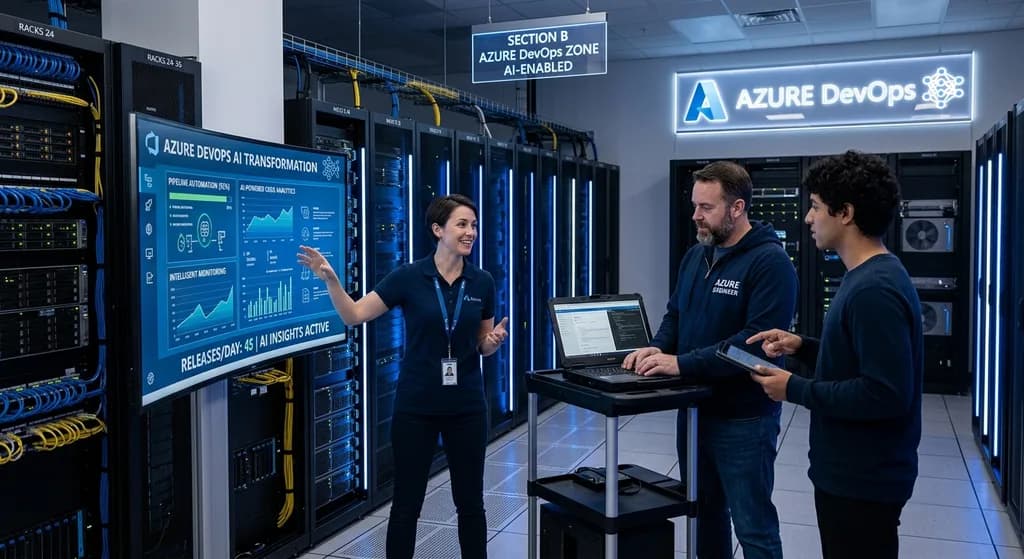
Operationalizing Azure DevOps AI Transformation for Platform Teams
Operationalizing Azure DevOps AI Transformation for Platform Teams
The push toward AI-Driven Development (AIDD) is fundamentally reshaping the software delivery lifecycle. While executive leadership—such as CTOs and COOs—focuses on the broad strategic advantages of artificial intelligence, the reality of implementing and securing these technologies falls directly onto DevOps engineers, Site Reliability Engineers (SREs), and platform teams. An Azure DevOps AI transformation is not merely about introducing new coding assistants to developers; it is a comprehensive overhaul of how infrastructure is provisioned, how pipelines are executed, and how system reliability is maintained at scale.
In modern enterprise environments, platform engineering teams are tasked with bridging the gap between high-level AI mandates and ground-level technical execution. This requires building robust, scalable architectures within the Azure ecosystem that can support AI workloads while simultaneously leveraging AI to improve day-to-day operations. This article explores the deep technical and operational changes required to successfully navigate and lead an Azure DevOps AI transformation.
The Platform Engineering Mandate for AI Integration
Platform teams exist to pave the "golden path" for development teams, reducing cognitive load and standardizing deployments. When undergoing an Azure DevOps AI transformation, this golden path must evolve to support intelligent, predictive workflows. Platform engineers must transition from maintaining static, rule-based CI/CD pipelines to designing dynamic ecosystems that adapt to code complexity, deployment risk, and historical test performance.
Moving Beyond Static Automation
Traditional automation in Azure DevOps relies on rigid YAML definitions. While effective, these pipelines lack context awareness. An AI-transformed platform utilizes machine learning models to analyze the vast amounts of telemetry generated during the build and release phases. By analyzing pipeline execution times, test flakiness, and deployment failure rates, AI can dynamically adjust concurrency limits, skip redundant tests, and optimize caching mechanisms. This drastically improves pipeline efficiency, saving valuable compute resources and accelerating feedback loops for development teams.
Engineering the AI-Ready Internal Developer Platform (IDP)
Integrating AI into your Internal Developer Platform (IDP) requires strict architectural governance. When developers utilize AI tools to generate code or infrastructure templates (like Bicep or Terraform), the volume of pull requests and deployments typically spikes. Platform teams must ensure that their Azure DevOps agents, runner pools, and artifact repositories can handle this increased velocity without degrading performance. Scaling runner pools dynamically using Azure Kubernetes Service (AKS) or Azure Container Apps, driven by predictive scaling algorithms, becomes a necessity rather than a luxury.
For specific implementation methodologies and operational architectures, platform engineers should review our deep dive on how to operationalize AI within your existing ecosystem to ensure seamless integration.
Rethinking CI/CD Pipelines in the Age of AI
Continuous Integration and Continuous Deployment (CI/CD) pipelines are the central nervous system of any DevOps operation. In an Azure DevOps AI transformation, these pipelines are augmented with intelligent decision-making capabilities.
Predictive Test Execution and Flake Analysis
One of the largest bottlenecks in enterprise CI/CD is test suite execution. As codebases grow, running comprehensive end-to-end tests on every commit becomes resource-prohibitive. AI models trained on your repository's commit history and test results can predict which tests are most likely to fail based on the specific files changed in a pull request.
DevOps engineers can integrate these predictive models into Azure Pipelines to dynamically select a subset of highly relevant tests for initial validation. Furthermore, AI-driven flake analysis can automatically detect non-deterministic tests, quarantine them, and open backlog items for SREs to investigate, preventing pipeline blockages caused by transient environmental issues.
Automated Rollbacks and Progressive Delivery
Deploying complex AI models or applications highly dependent on AI APIs requires mature progressive delivery mechanisms. Azure DevOps, when combined with AI-driven observability tools, allows platform teams to execute sophisticated canary releases. During a canary deployment, AI algorithms continuously monitor the new deployment's telemetry (CPU usage, memory consumption, latency, error rates) against the baseline.
If the AI detects statistically significant anomalies, it can automatically trigger a rollback via Azure DevOps release pipelines. This reduces reliance on manual SRE intervention and significantly lowers the Mean Time to Recovery (MTTR) during botched deployments.
Site Reliability Engineering (SRE) and AI-Augmented Operations
For SREs, system reliability is the ultimate metric. The introduction of AI into the Azure DevOps ecosystem provides powerful new mechanisms for managing incidents, reducing toil, and maintaining Service Level Objectives (SLOs).
AIOps and Intelligent Alerting
Alert fatigue is a chronic issue for operations teams. Traditional threshold-based alerting in Azure Monitor often results in massive alert storms during complex system outages. An Azure DevOps AI transformation incorporates AIOps principles to aggregate, correlate, and prioritize alerts based on their actual impact on user experience.
By leveraging machine learning anomaly detection within Azure Application Insights and Azure Log Analytics, SREs can shift from reactive firefighting to predictive maintenance. The AI can identify subtle degradation in system performance—such as a slow but steady increase in database query latency—and alert the SRE team before it breaches the defined SLOs.
Automated Root Cause Analysis (RCA)
When a high-severity incident occurs, SREs must sift through gigabytes of logs, metrics, and traces to identify the root cause. AI tools deeply integrated into the Azure ecosystem can ingest this telemetry in real-time and correlate it with recent deployment events from Azure DevOps. By surfacing the most probable root cause—such as a specific configuration change in a recent pull request—AI drastically reduces the Mean Time to Identify (MTTI) and allows operations teams to restore service faster.
Security, Governance, and Guardrails
With AI empowering developers to write code faster, the velocity of potential vulnerabilities entering the codebase also increases. Platform engineering and security teams must collaborate to enforce strict, automated guardrails within the Azure DevOps pipelines.
Securing AI-Generated Code
AI coding assistants are trained on public repositories and can inadvertently introduce insecure coding patterns or outdated dependencies. DevOps engineers must implement rigorous Static Application Security Testing (SAST), Dynamic Application Security Testing (DAST), and Software Composition Analysis (SCA) directly into the pull request workflow.
However, traditional security tools often produce high rates of false positives. AI-augmented security scanning can contextualize these findings, filtering out noise and prioritizing critical vulnerabilities based on their exploitability within your specific Azure architecture. This ensures that security remains a continuous, frictionless part of operations.
Infrastructure as Code (IaC) and Policy as Code
As teams adopt AI-Driven Development, the generation of Infrastructure as Code (IaC) templates will accelerate. Platform teams must enforce Policy as Code using tools like Azure Policy and Open Policy Agent (OPA). By integrating policy evaluation into the Azure DevOps CI pipeline, platform teams can automatically reject AI-generated infrastructure configurations that violate organizational compliance standards—such as missing encryption tags, overly permissive network security groups, or unauthorized region deployments.
FinOps: Managing the Cost of AI Workloads
AI transformations are resource-intensive. Training models, hosting inference APIs, and running AI-augmented pipelines consume significant cloud compute. DevOps engineers and SREs are increasingly responsible for implementing FinOps practices to ensure cloud spend remains sustainable.
Optimizing Resource Efficiency
Platform teams must establish strict resource allocation quotas and utilize spot instances for non-critical, interruptible AI training workloads within Azure Machine Learning. Furthermore, AI itself can be used to optimize cloud spend. Predictive scaling algorithms can analyze historical traffic patterns to precisely scale AKS clusters or App Service plans down during off-peak hours, ensuring maximum operational efficiency without sacrificing performance.
DevOps engineers should create comprehensive dashboards within Azure DevOps that link deployment metadata to cloud consumption metrics, providing CTOs and COOs with transparent visibility into the return on investment (ROI) of their AI initiatives.
Measuring Success: DORA Metrics and Beyond
To prove the value of an Azure DevOps AI transformation, platform teams must capture and analyze the right metrics. While leadership may look at high-level business outcomes, SREs and DevOps engineers should focus on operational performance indicators.
AI's Impact on DORA Metrics
- Deployment Frequency: As AI assists in writing, reviewing, and testing code, deployment frequency should naturally increase. Platform teams must ensure the CI/CD infrastructure can support this without throttling.
- Lead Time for Changes: AI-driven code reviews and predictive test execution reduce the time it takes for a commit to reach production. SREs should track this metric to identify pipeline bottlenecks.
- Mean Time to Recovery (MTTR): Through AIOps, intelligent alerting, and automated rollbacks, AI should significantly reduce MTTR. This is the clearest indicator of operational efficiency.
- Change Failure Rate: By utilizing AI to predict deployment risks and enforce automated compliance checks, the percentage of deployments resulting in a failure should decrease.
By establishing strong baseline measurements before implementing AI tooling, platform teams can continuously monitor these metrics to validate the success of the transformation.
Conclusion
The Azure DevOps AI transformation is a profound operational shift. For DevOps engineers, SREs, and platform teams, it requires moving beyond legacy automation and embracing intelligent, predictive systems. By architecting scalable infrastructure, enforcing rigorous security guardrails, leveraging AIOps for incident management, and prioritizing resource efficiency, operations teams can successfully execute the AI mandates set by leadership. Ultimately, this transformation empowers engineering organizations to build more resilient, secure, and highly performant software ecosystems at unprecedented scale.